
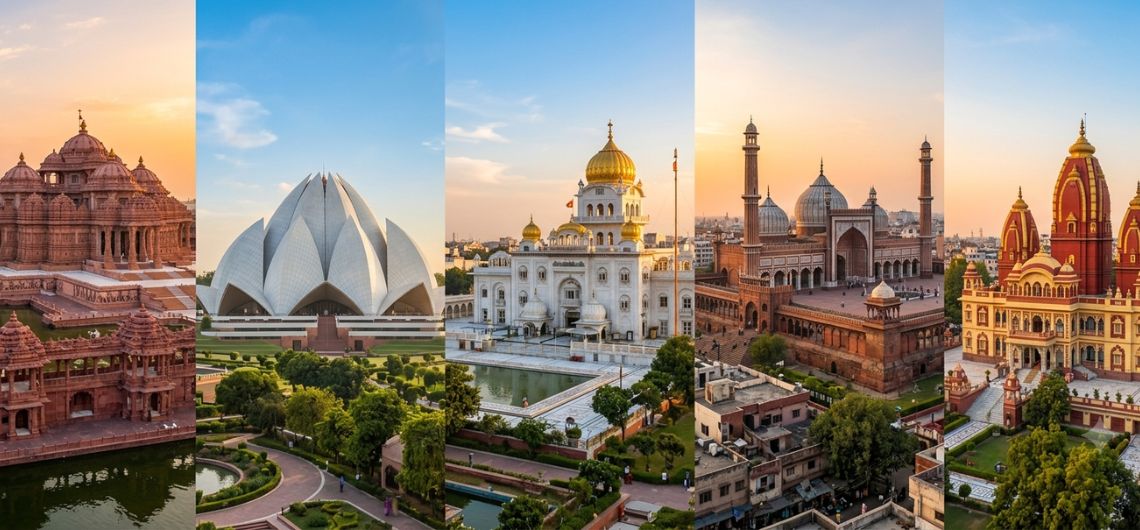
Delhi is often described through its forts and tombs, but the capital is just as much a city of faith. Within a few kilometres you can pass a Hindu temple of carved pink sandstone, a Sikh gurudwara serving free meals to thousands, a Bahá’í House of Worship shaped like a lotus flower, and one of India’s grandest mosques.
For travellers, these places show how Indian religions sit side by side in daily life. This guide covers the key spiritual sites, what makes each special, and how to visit them comfortably, even if you only have one day.
Why Visit Delhi’s Spiritual Sites?
You don’t need to be religious to enjoy them. These places offer:
- Architecture: carved stone, marble domes and modern design
- Living culture: people actually praying, singing and sharing food
- Calm: many of these sites are quieter than the city around them
- Variety: Hinduism, Sikhism, Islam and the Bahá’í Faith in a single day
1. Akshardham Temple: Delhi’s Most Spectacular Temple
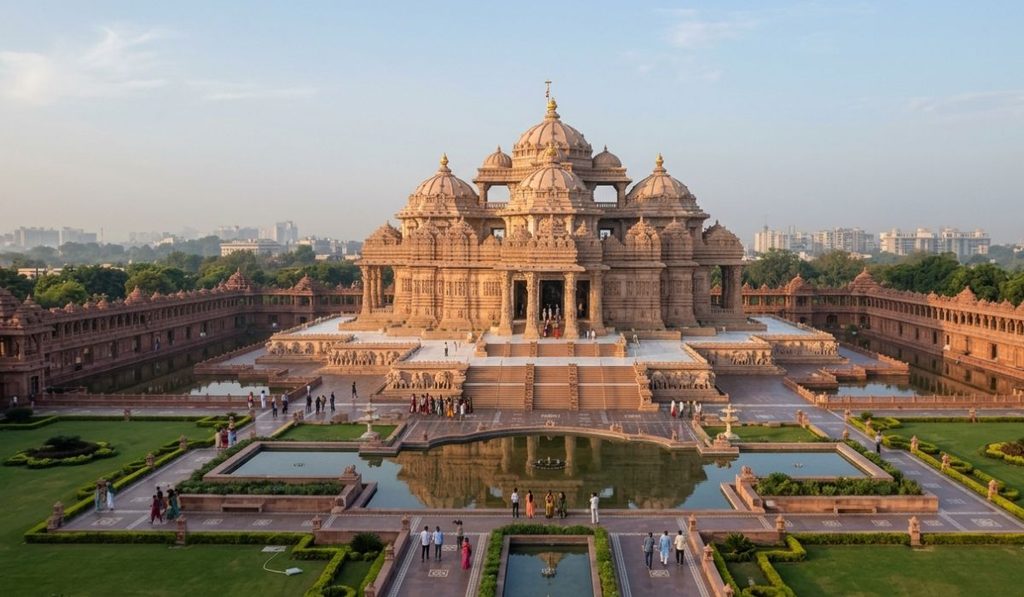
Akshardham, built by the BAPS Swaminarayan organisation and opened in 2005, is the first stop most visitors want to see. It is built from pink sandstone and white marble, and its walls and pillars are covered in detailed carving. The complex has hundreds of carved pillars, domes and thousands of sculpted figures. Guinness World Records recognised it in 2007 as the world’s largest comprehensive Hindu temple.
What to know before you go
- Phones, cameras, bags and other electronics are not allowed inside. Lockers are available at the entrance.
- Dress modestly, with shoulders and knees covered.
- The temple is usually closed on Mondays.
- Allow extra time for security checks, as it is one of Delhi’s most visited attractions.
- In the evening, the complex hosts a water and light show (separately ticketed), which is why many travellers also see Akshardham on a Delhi night tour.
2. Gurudwara Bangla Sahib: Peace, Music and Free Meals
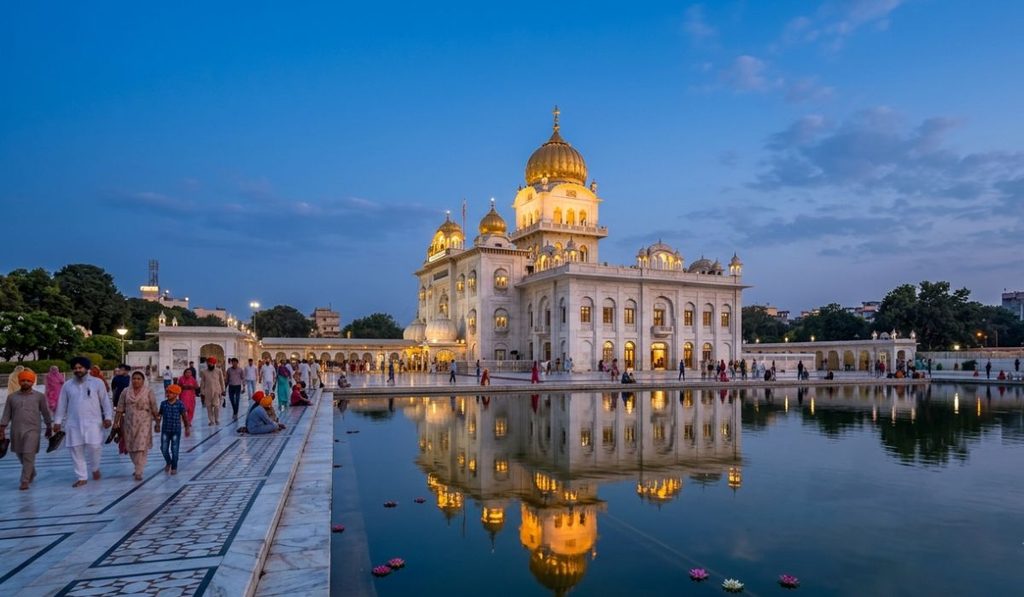
Near Connaught Place, Gurudwara Bangla Sahib is one of Delhi’s most important Sikh shrines. It is linked to the eighth Sikh Guru, Guru Har Krishan, who stayed here in 1664 and cared for the sick during an epidemic. The water in the sacred pool (the sarovar) is still revered by many visitors for that reason.
Its gold dome and white marble buildings are beautiful, but most people remember the atmosphere: devotional hymns (kirtan) drifting over the courtyard and the community kitchen (langar) serving free vegetarian meals to anyone, of any faith, every day.
What to know before you go
- Cover your head (scarves are usually available at the entrance), remove your shoes and wash your feet before entering.
- Visitors of all faiths are welcome.
- Try the langar meal. Eating with the community is one of the most memorable experiences in Delhi.
- It is usually open throughout the day and is lovely in the early morning or at dusk.
3. Lotus Temple: A Modern Place of Quiet Reflection
The Lotus Temple is a Bahá’í House of Worship, completed in 1986 and designed by architect Fariborz Sahba. Its white marble petals, 27 in total, form a lotus flower surrounded by pools and gardens. Visitors of every religion are welcome to sit in the silent prayer hall.
What to know before you go
- Silence is expected inside the hall, and photography is not allowed there.
- Entry is free, but queues can be long on weekends.
- It is usually closed on Mondays.
- The gardens make it a calm break in a busy sightseeing day.
4. Birla Mandir (Laxminarayan Temple): A Classic Hindu Temple
Birla Mandir, close to Connaught Place, was built by the Birla family and inaugurated by Mahatma Gandhi in 1939. It is dedicated to Lakshmi and Vishnu (Narayan). Its orange-and-cream towers, marble interiors and shrines make it an easy introduction to Hindu temple traditions.
What to know before you go
- Remove your shoes, and don’t expect to use a phone or camera inside.
- Visit in the morning or evening to catch the aarti (devotional ritual with lamps and music).
- Entry is free.
5. Jama Masjid: Old Delhi’s Great Mosque
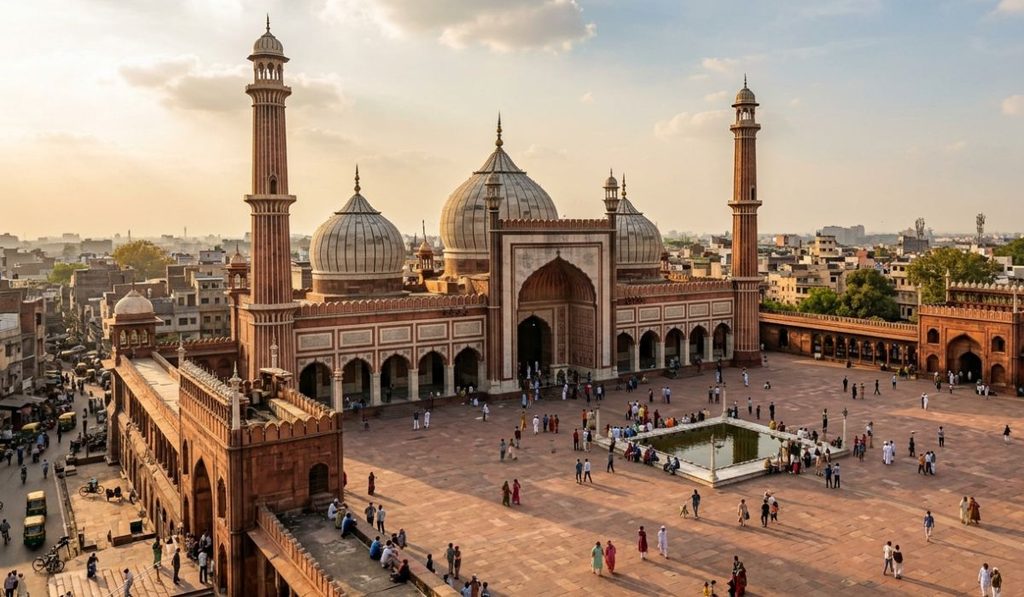
Built by Emperor Shah Jahan between 1650 and 1656, Jama Masjid is one of India’s largest mosques, with a courtyard that holds around 25,000 worshippers. Its red sandstone and white marble domes dominate the Old Delhi skyline.
What to know before you go
- Non-Muslim visitors are welcome outside prayer times, so plan around them.
- Dress modestly, with arms and legs covered. Cover-ups are often offered at the gate.
- Pair it with a walk through Chandni Chowk, and try the street food nearby afterwards.
Other Spiritual Places Worth Knowing
If you have extra time, consider:
- Sis Ganj Sahib in Chandni Chowk, an important Sikh shrine
- ISKCON Temple (East of Kailash), known for its devotional music
- Nizamuddin Dargah, the Sufi shrine where qawwali music is usually performed on Thursday evenings
Sample One-Day Spiritual Itinerary
Many of these sites have fixed closing days and prayer times, so the order matters. A sensible flow looks like this:
- Morning: Gurudwara Bangla Sahib and Birla Mandir, which are close together
- Late morning: Jama Masjid, outside prayer times
- Afternoon: Lotus Temple
- Late afternoon or evening: Akshardham
Doing all this independently means managing traffic, security queues, shoe removal and timings at each site. A guided tour handles that for you.
See It All with My Taj Tour
Our Delhi City Tour of Temples & Spiritual Sites is an 11-hour day covering Delhi’s key sacred places, including the Lotus Temple, Akshardham, Birla Mandir, Jama Masjid and Gurudwara Bangla Sahib.
- Hotel pickup and drop-off
- An experienced English-speaking guide who explains the history and etiquette
- Skip-the-line entry where applicable
- Comfortable air-conditioned transport
- Over 425 traveller reviews, from $85
Want more of the city? Compare all our Delhi tour packages. If you are continuing to Agra and Jaipur, see our Golden Triangle tour packages.
Visitor Tips for Delhi’s Religious Sites
- Dress modestly: cover shoulders and knees, and carry a scarf.
- Wear easy shoes: you will remove them often. Socks are fine at most sites.
- Carry little: several sites restrict bags and electronics.
- Respect rules on photography: some areas ban it.
- Best time to visit: October to March, when Delhi is cool. Summers are very hot, so start early.
- Check closing days: Akshardham and Lotus Temple are usually closed on Mondays.
FAQs
How many days do you need to see Delhi’s temples?
One full day covers the major sites. Add a second day to include Sufi and Sikh sites in Old Delhi and spend more time at Akshardham.
Can tourists of any religion visit?
Yes. All the places above welcome visitors of every faith. Follow the dress code and local etiquette.
Are Delhi temples free to enter?
Most are free, including Lotus Temple, Bangla Sahib and Birla Mandir. Some attractions inside Akshardham, such as exhibitions and the evening show, are ticketed.
Is the Delhi temples tour suitable for families and older travellers?
Yes. Transport is private and air-conditioned, and the pace can be adjusted. Mention any mobility needs when booking.
Can I combine this with a Taj Mahal trip?
Yes. Many guests spend a day in Delhi and then take a Taj Mahal tour the next day.
Final Thoughts
Delhi’s sacred places show a side of India that monuments alone can’t. In one day you can hear devotional music, share a free meal and sit in silence beneath a marble lotus. With the right plan, or a guide to handle it, the experience is easy to enjoy.
Ready to explore? Book the Delhi Temples & Spiritual Sites Tour with My Taj Tour.

Comments